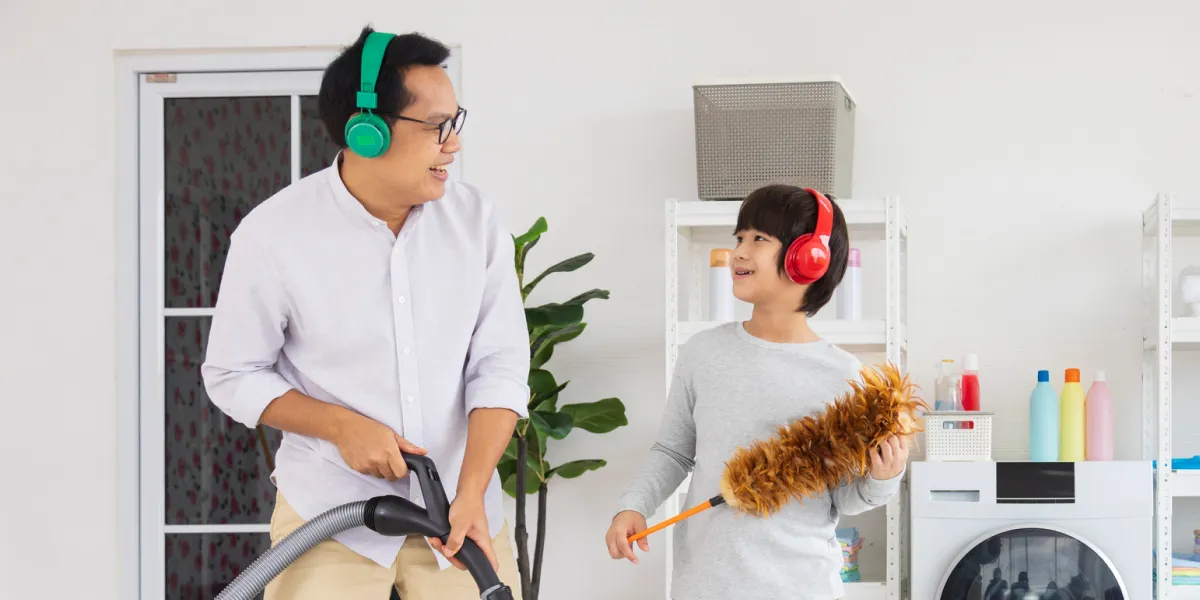
Chores are an essential part of growing up and learning to take responsibility for one’s actions. They provide kids with a sense of accomplishment and independence as they learn to care for themselves and their surroundings. While chores may not always be the most exciting tasks, they’re a great way to teach kids essential life skills.
Of course, we know that chores teach kids responsibility and accountability, but giving your kids chores has so many other benefits.
Here are 10 amazing benefits to giving your kids chores (apart from getting things done around the house!)
It helps them develop their money smarts
Children who received an allowance for doing chores were more likely to develop good money management skills as they got older1.
By giving your children pocket money for completing chores, you are teaching them valuable lessons about how money works and how they can work for it. This will help them develop good money management skills they will need throughout their lives. In addition, children who learn to earn money through chores are more likely to understand the value of money and be more responsible with it.
The payoff shows up in the data: according to the FY26 Spriggy Economy Report, Spriggy kids who complete at least one job save 2x as much of their pocket money as those who don’t.2
See how Spriggy can help your kids build their money smarts.
It builds their self-esteem
Giving children chores can help them develop a sense of competence and autonomy3.
Completing chores gives children a sense of accomplishment, which can do wonders for their self-esteem. When children feel that they have contributed to the family by completing their assigned jobs, they feel a sense of pride in their achievements. This can help them to feel more confident in their abilities and more willing to take on new challenges.
They’ll feel like a part of the team
Doing chores together as a family can help children learn to work together towards a common goal4. When children contribute to the family by completing chores, they feel like integral members of the team. It helps build their sense of community and makes them feel valued and important in the family unit. This sense of collaboration can translate into other areas of their lives, such as group projects at school or sports teams. They begin to understand that everyone has a role and that working together can lead to greater success.

They’ll start to become more independent
Children given age-appropriate household chores tend to be more independent than those not given chores5.
Doing chores can help kids develop a sense of independence as they learn to complete tasks on their own. As a result, they gain confidence in their abilities and become more self-reliant. This sense of independence can be empowering and help them develop a positive self-image.
They’ll get better at time management
Completing chores can help children learn to prioritise and manage their time effectively6. Chores help children learn to prioritise their tasks and complete jobs within a deadline. The time management skills they pick up now will serve them well in their personal and professional lives.
It’ll enhance their problem-solving abilities
When children encounter challenges while completing a task, they learn to think creatively to find a solution. This helps them hone their problem-solving skills, which can positively impact how they deal with challenges in other areas, such as school, work, and personal relationships7.
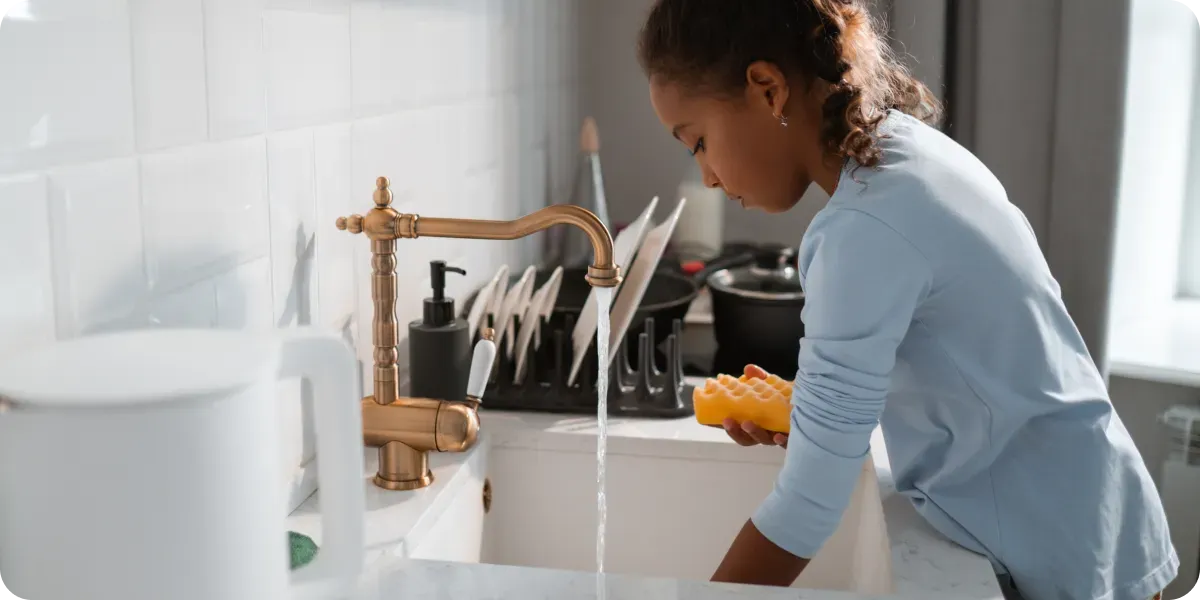
They’ll learn to multitask
Chores often require children to juggle multiple tasks at once, such as cleaning up a room while also doing laundry. Learning to manage more than one thing at one time is a handy (and essential) talent to have. And the younger kids learn it, the better they’ll be at it.
They’ll start paying attention to detail
Performing tasks like cleaning or organising requires attention to detail, which can help kids improve their focus and concentration8.
They begin to understand that every little detail matters and that taking the time to do things right can lead to better quality and outcomes.
It’ll help instil a strong work ethic
Doing chores teaches kids the value of hard work and perseverance. They’ll learn not to cut corners and pride themselves in their work.
Chores keep up with the times, too. As Australia’s EV sales doubled, “put the car on charge” chores doubled as a share of all chores, according to the FY26 Spriggy Economy Report.
They’ll learn respect and compassion
Chores that involve caring for pets or younger siblings can teach kids empathy and respect for others9. They begin to understand the needs of others. This respect for others can translate into other areas of their lives, such as treating classmates and coworkers with kindness and understanding.
Footnotes
-
Xia, Y., & Kelley, K. (2019). Does an allowance make cents? The impact of allowances on children’s financial literacy. Journal of Family and Economic Issues, 40(2), 225–239. ↩
-
Spriggy Economy Report FY26. Spriggy internal data covering 1 July 2025 to 30 June 2026. ↩
-
The effects of household chores on the self-esteem and development of responsibility in children. Journal of Family Psychology, 27(6), 974–982. ↩
-
Johnson, A. D., & LaVoie, J. C. (2019). The effects of family chore involvement on teamwork and communication. Journal of Marriage and Family, 81(1), 49–63. ↩
-
Steinberg, L., & Silk, J. S. (2002). Parenting adolescents. Handbook of parenting, 1, 103–133. ↩
-
Gassman-Pines, A., & Yoshikawa, H. (2006). The effects of antipoverty programs on children’s time use and psychological well-being. Journal of Child and Family Studies, 15(2), 157–174. ↩
-
Rittle-Johnson, B., & Star, J. R. (2009). Compared with what? The effects of different comparisons on conceptual knowledge and procedural flexibility for equation solving. Journal of Educational Psychology, 101(3), 529–544. ↩
-
Kim, S. Y., Wang, Y., Orozco-Lapray, D., Shen, Y., & Murtuza, M. (2013). Does “tiger parenting” exist? Parenting profiles of Chinese Americans and adolescent developmental outcomes. Journal of Family Issues, 34(5), 631–658. ↩
-
Bono, G., Emmons, R. A., & McCullough, M. E. (2004). Gratitude in practice and the practice of gratitude. In R. A. Emmons & M. E. McCullough (Eds.), The psychology of gratitude (pp. 264–281). Oxford University Press. ↩